Have you ever experienced such a scene in the filling workshop—wet floors all the time, liquid on bottles impossible to wipe clean, foam overflowing from bottle mouths, workers rushing to adjust the filling volume, yet each barrel still weighing differently? Even more troublesome is that when switching to a material with a different viscosity, the whole set of equipment seems to “go on strike”—either failing to fill properly or filling inaccurately.
To be honest, during my years in production management, what I fear most is receiving a call from the workshop: “The filling machine is acting up again, material is splashing everywhere, we probably can’t ship this batch today.” That anxiety, helplessness, and even the urge to complain are surely familiar to fellow industry peers.
Later, we came across a manufacturer that truly understands filling pain points—Guangzhou Marchi Packaging Equipment Co., Ltd. Instead of pitching machines right away, its team first asked us three questions: What material are you filling? Do you have many bottle specifications? Are there requirements for foam and oxidation? These three questions hit all the pitfalls we had encountered before.
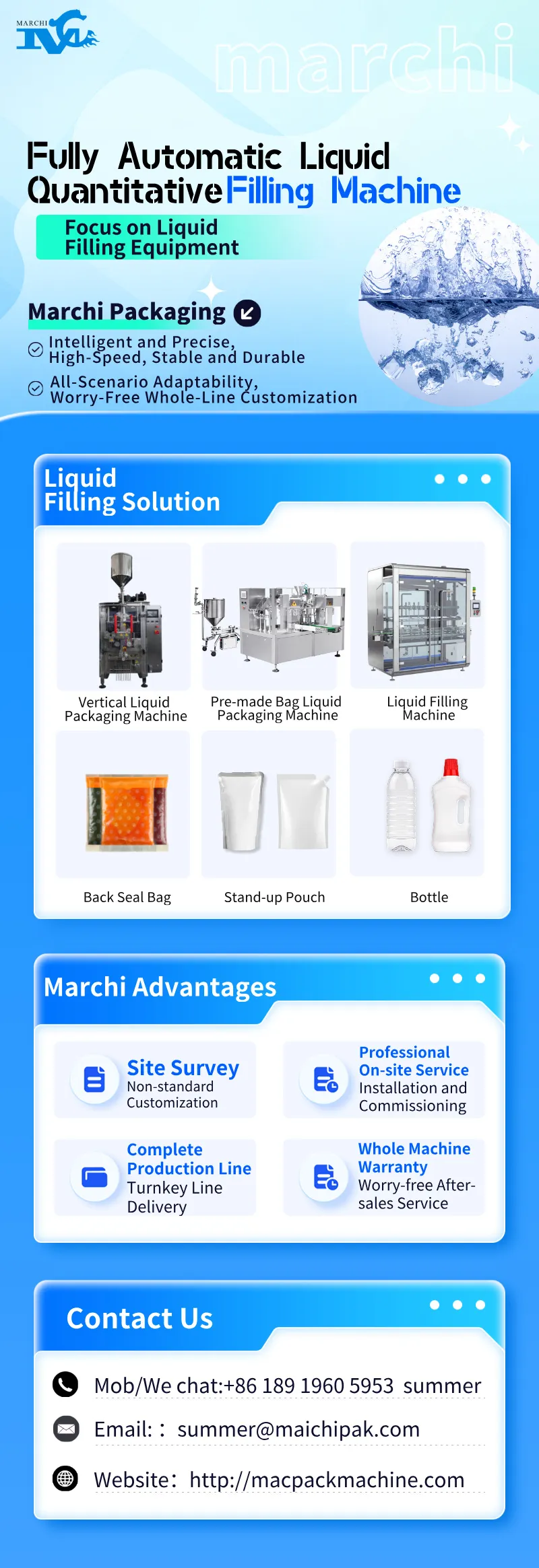
With a try-out attitude, we introduced a fully automatic liquid quantitative filling machine (also known as a liquid weighing filling machine or paste-liquid filling machine). Frankly speaking, I was a bit skeptical at first—they’re all filling machines, how different could they be? But after one month of use, I admit we made the right choice this time.
What exactly makes it outstanding? Here are a few impressive features:
Marchi’s MCYT-CZ-2T Double-Head Weighing Filling Machine. Despite having only two filling heads, its capacity is remarkable—it can stably fill 240 barrels of 30kg specification per hour. The key lies in its accuracy, with filling error controlled within ±0.3%, which is quite competitive in the field of liquid weighing filling.
The equipment adopts a programmable controller combined with high-speed industrial control configuration software, enabling real-time monitoring of the entire filling process. Each filling head is equipped with an independent weighing and feedback system, meaning you can set and fine-tune the filling volume of each head separately. Previously, with our old equipment, four heads produced four different weights; now each head operates independently with outstanding stability.
Two additional details are particularly practical. First, photoelectric sensors and proximity switches ensure no filling without barrels, and the host automatically stops and alarms in case of barrel blockage. Second, the submersible filling method—the filling head extends to the bottom of the barrel before starting filling, greatly reducing foam generation. This feature is a lifesaver when we fill dish soap and thinners.
What Can It Fill and Where Can It Be Applied?
Frankly speaking, this machine has a wide range of applications. We have tested water-based coatings, oily solvents, liquid fertilizers, pesticides, dish soap, engine oil, antifreeze, honey, juice concentrates, creams, adhesives, emulsions, and more—basically all free-flowing liquids or pastes with certain viscosity can be handled.
Moreover, it is compatible with various bottles. Bottle dimensions range from 160 to 360mm in length, 100 to 300mm in width, and 250 to 500mm in height; round bottles, square bottles, large barrels, small barrels with a diameter of over 40mm are all applicable. The whole machine is manufactured in accordance with GMP standards, with all material-contacting and exposed parts made of stainless steel, and quick-install pipelines for easy disassembly and cleaning. We frequently switch between different products; cleaning the equipment used to take half a day, but now it can be done in about an hour.
In terms of service coverage, Marchi has a nationwide layout. From Harbin, Changchun, Shenyang in Northeast China, Beijing, Tianjin, Shijiazhuang, Jinan, Qingdao in North China, Shanghai, Nanjing, Suzhou, Hangzhou, Hefei in East China, Guangzhou, Shenzhen, Dongguan, Nanning in South China, Chengdu, Chongqing, Kunming, Guiyang in Southwest China, to Xi’an, Lanzhou, Urumqi in Northwest China—for almost every named city, they can send personnel for on-site installation, commissioning and training.
How Does It Work? A Step-by-Step Process
Before startup, set the target filling volume on the touch screen. Bottles are conveyed to the bottom of the filling heads via a conveyor belt; the photoelectric sensor detects the barrel in position, and the filling head automatically submerges to the barrel bottom. The weighing system then provides real-time weight feedback. When approaching the set value, the PLC controls the valve to switch from fast filling to slow replenishment, finally stopping accurately. The filling head rises, and the bottle moves forward—the whole process is smooth without unnecessary pauses or a single drop of material wasted.
Solutions to Customers’ Top Concerns
Pain Point 1: Inaccurate filling with inconsistent barrel weights.
Solution: Each head of Marchi MCYT-CZ-2T features independent weighing feedback, coupled with PLC closed-loop control, enabling real-time correction even with changes in material viscosity or air pressure fluctuations. Our actual measurement of dozens of barrels shows a maximum deviation of no more than 0.3%.
Pain Point 2: Excessive foam and material overflow during filling.
Solution: Submersible filling keeps the filling head below the liquid level, virtually eliminating foam generation. For highly foaming materials, an anti-foam device is available as an option.
Pain Point 3: Troublesome material and bottle switching.
Solution: Quick-install pipelines + wide adjustable bottle range. Cleaning requires no tools and can be completed in minutes. Bottle parameters can be stored for one-click recall during subsequent production changes.
Pain Point 4: Some materials are prone to oxidation, or the workshop has explosion-proof requirements.
Solution: Marchi provides explosion-proof model configurations, and supports nitrogen filling protection or inert gas replacement to prevent material oxidation and deterioration due to air contact. You can communicate directly with the manufacturer, who will provide solutions based on your material characteristics.
Summary
When selecting equipment, you really can’t just look at the price. We once bought several “similar-looking” filling machines on the cheap, only to find that maintenance costs, material loss and labor costs combined were far more expensive than purchasing high-quality equipment. Now this Marchi weighing filling machine has been running stably for nearly a year without major failures, maintaining consistent accuracy.
If you are also troubled by accuracy, foam and cleaning issues in liquid and paste filling, consider consulting Guangzhou Marchi Packaging Equipment Co., Ltd. They don’t just sell you a machine—they help you optimize the entire filling process, providing reliable solutions covering model selection, core configurations (such as explosion-proof or anti-oxidation requirements), process details and key parameters.