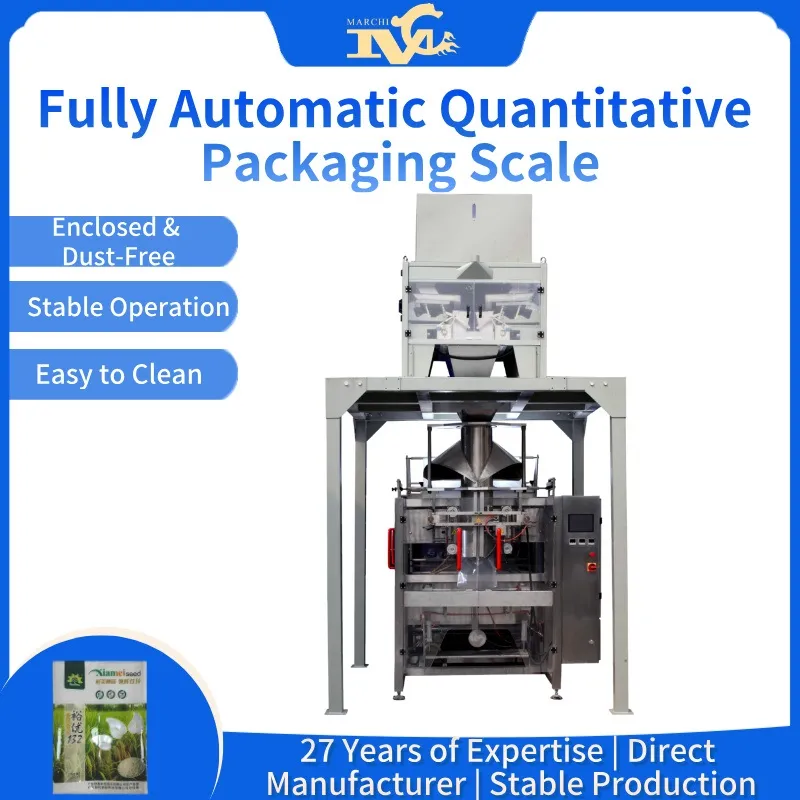
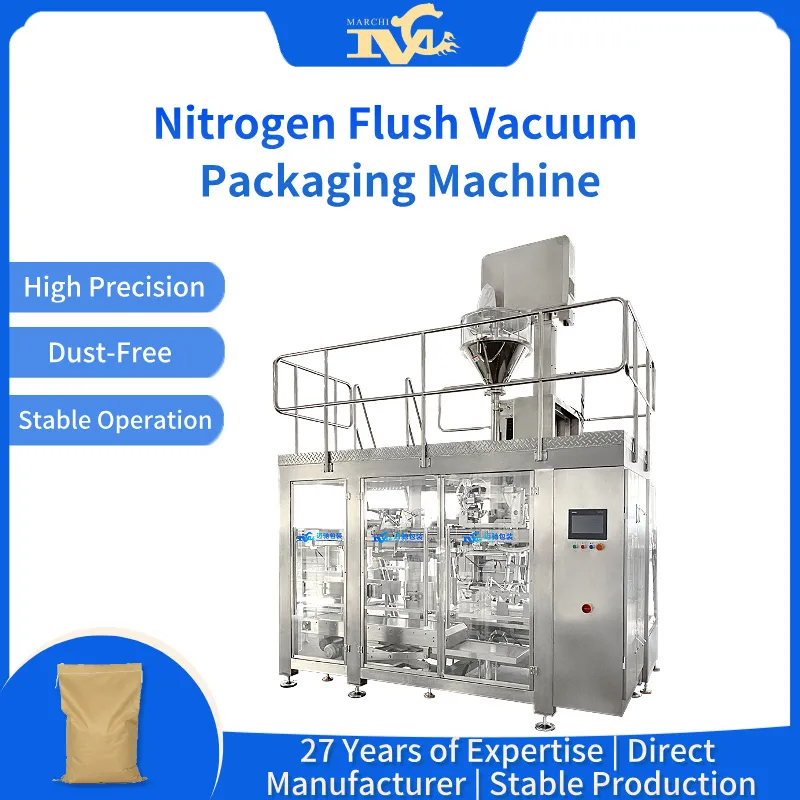
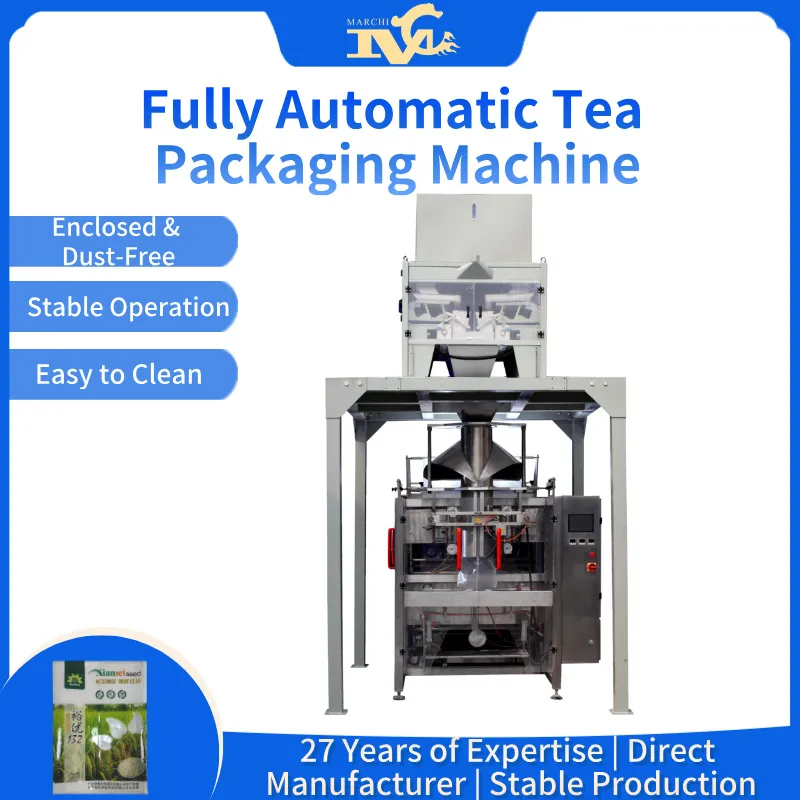
The 25kg powder packaging machine developed by Guangzhou Maichi Packaging Equipment Co., Ltd. has attracted industry attention in the field of pre-mixed powder packaging. The equipment adopts a single-screw feeding system, with packaging accuracy controllable within ±0.1% to 0.2%.
Direct drive by servo motors ensures metering speed and precision, realizing a fully automated process from bag fetching, positioning, and opening to filling.
01 Industry Background
The packaging machinery industry is at a critical juncture of technological upgrade. With increasing demands for powder packaging accuracy and efficiency in industries like chemicals, food, and pharmaceuticals, traditional manual packaging methods can no longer meet modern production needs.
The challenge of packaging density has long been a major factor limiting powder packaging efficiency. Particle size distribution has a dominant influence on bulk density; a wider particle size distribution typically yields higher bulk density.
The shift towards automation has become a key link for enterprises to enhance efficiency and reduce costs. The application of fully automatic packaging equipment is transforming traditional production models, especially as demand for packaging 25kg specifications of powder, granules, and liquid materials grows.
02 Equipment Technology Analysis
Guangzhou Maichi's MCZD-25F fully automatic powder packaging machine integrates functions like automatic weighing, automatic bag feeding, automatic filling, and automatic heat-sealing/sewing, achieving true unmanned operation.
Core technical features of this equipment include the single-screw feeding method and servo motor direct drive, ensuring metering speed and accuracy. The load cell and weighing controller work in tandem to process weight signals and output data in real-time.
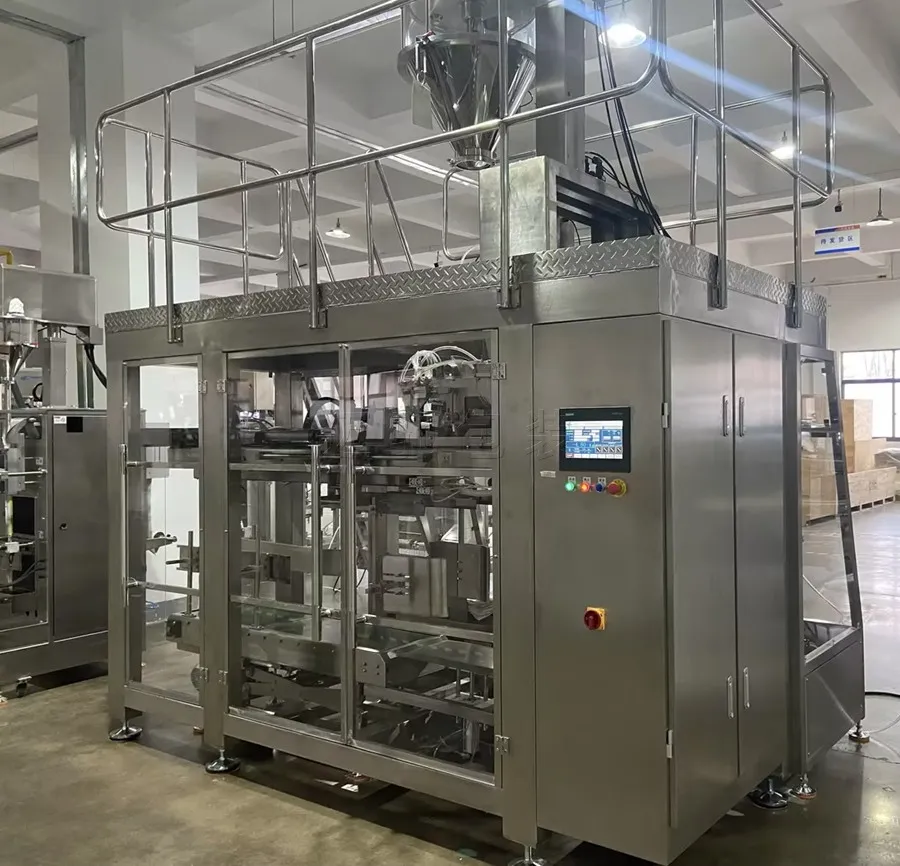
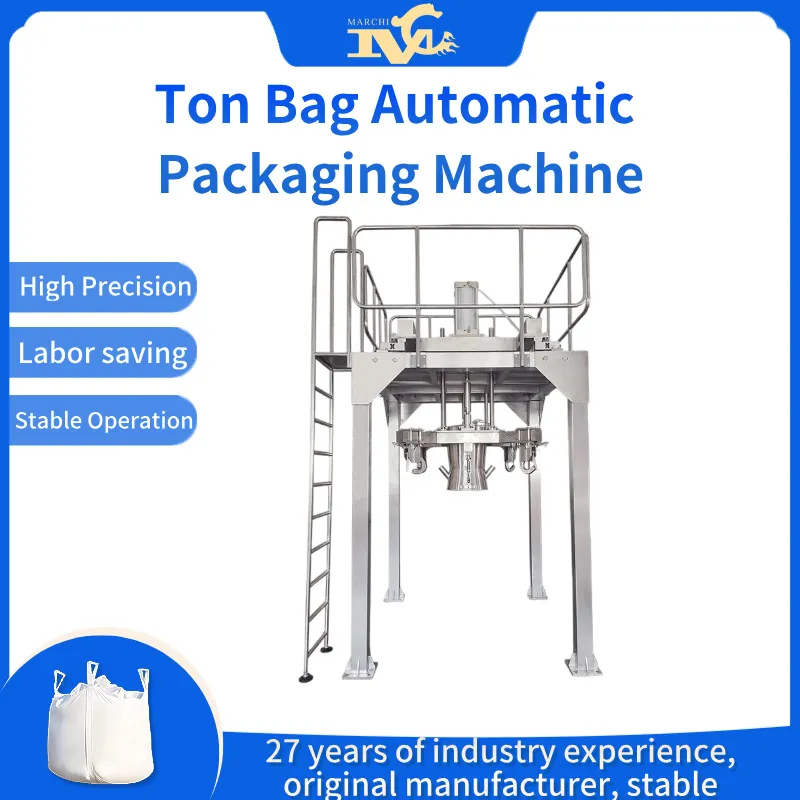
The equipment consists of a bag magazine, bag fetching/orienting device, bag feeding manipulator, bag clamping and discharging device, bag holding and pushing device, bag mouth guiding device, vacuum system, and control system.
Key technical parameters show a packaging weight range of 5-25kg, a packaging speed of up to 1.5-2 bags/minute, and adaptability to bag lengths of 500-1000mm. The machine is compatible with various bag materials including laminated kraft paper bags, woven bags, and plastic bags.
03 Application Scenarios and Technical Advantages
The packaging machine has wide applicability, being particularly suitable for handling various powdered materials, including milk powder, soy milk powder, starch, seasoning powder, coffee powder, glucose, veterinary drugs, pesticide powders, etc.
Powdered materials in the building materials and chemical industries, such as cement powder, lime powder, and resin powder, are also suitable for this packaging solution.
Density control technology in powder packaging deserves special attention. Research indicates that particle size distribution has a dominant influence on bulk density; a wider particle size distribution typically yields higher bulk density.
Technical advantages are reflected in multiple aspects: modular design, user-friendly operation interface, and easy maintenance. The control system utilizes PLC and touch-screen HMI (Human-Machine Interface), making parameter setting and adjustment simple and intuitive.
The design emphasizes sealing and dust prevention. For materials prone to generating dust, specialized dust collection ports or suction devices can be equipped.
04 Automated Packaging Process
The automated process of the powder packaging machine exemplifies the efficient operation of modern industry. The entire process begins with bag fetching, where a robotic arm precisely grabs a pre-made bag, and a positioning system ensures accurate alignment of the bag mouth.
Advanced technologies are used in the bag opening and filling stages. Assisted by a vacuum system for opening, the screw feeding system begins discharging material according to preset parameters. The load cell monitors weight changes in real-time, automatically stopping discharge when the target weight is reached.
In the sealing and finished product handling stage, the bag mouth is arranged and then enters the heat-sealing/sewing device. After sealing is completed, the bag is transported out by a conveyor belt, with no manual intervention required throughout the entire process.
This process is specifically optimized for density control in pre-mixed powder packaging. By adjusting the screw feeding speed and discharge mode, it can adapt to powder materials with different bulk densities, ensuring packaging efficiency and accuracy.
05 Industry Pain Points and Solutions
The powder packaging industry faces challenges with dust control. Ultra-fine powders easily generate dust during packaging, leading not only to material waste but also potentially affecting the working environment and operator health.
Solutions include adopting bottom-fill bag feeding methods and sealed packaging equipment to reduce material contact with air. For materials with high air content, using vacuum pumps and microporous tube automatic degassing technology helps minimize dust dispersion risk.
Packaging accuracy stability is another major challenge. Variations in material specific gravity and air content fluctuations can affect weighing accuracy, potentially leading to issues like "bag bursting" or unstable stacking after packaging.
Targeted measures include equipping large-capacity weighing hoppers and vertical screw forced feeding systems to improve metering accuracy through dynamic compensation technology. Employing degassing processes reduces the air content within the material, ensuring packaging stability.
Insufficient packaging seal integrity can lead to leaks during transportation or storage. This is particularly problematic for large 25kg packages, where seal failure can cause significant losses.
Improvement solutions involve multi-layer reinforced sealing technology: using smaller sealed bags for inner packaging with reinforced bag openings, and employing rigid cardboard boxes filled with cushioning material for the outer layer. For materials with special properties, dedicated packaging equipment and materials are necessary, along with corresponding warning labels.
06 Future Development Trends
As automation technology continuously advances, packaging machine operation interfaces are becoming more streamlined. Workers can now complete most parameter adjustments via touchscreens.
Dust concentration in packaging workshops has significantly decreased, improving the working environment and reducing occupational disease risks. Finished products at the end of the packaging line are neatly stacked with uniform bag shapes, facilitating subsequent warehousing and transportation.
With the ongoing innovation in 25kg powder packaging technology, this once labor-intensive process is becoming increasingly efficient, precise, and clean.